
At 1 a.m. the house is dark except for the hallway light, and a 5-year-old 48-pound Australian shepherd mix is pacing from bedroom to back door, panting, licking her lips, then settling for three minutes before popping up again. Her owner has already let her out twice, offered water, dimmed the lights, and whispered reassurance, and nothing holds for more than a few minutes. The question she is really asking is not about bedtime, but about regulation: why does this dog’s nervous system stay on patrol when the day is over, and what would help her stand down through the night.
My verdict-first answer is direct. Organize the whole toolkit around one pattern: nighttime restlessness from unresolved daytime arousal and Heart Shen restlessness. In Traditional Chinese Veterinary Medicine terms, the Shen houses calm awareness, and when daytime stress, fear, noise sensitivity, pain, or irregular routine agitates Heart Qi, the Shen cannot anchor at night. That single pattern explains why isolated bedtime fixes disappoint, why daytime rhythm matters more than a late-night chew, and why calming herbs and amino acids may help support balance and healthy function rather than force sleep.
Why an aroused brain cannot hand off to sleep
Sleep onset in dogs depends on a predictable downshift from sympathetic arousal to parasympathetic rest. Cortisol and adrenaline need to fall, body temperature needs to drop slightly, and environmental cues need to signal safety. An anxious dog stays chemically primed for threat detection: light sleep, frequent position changes, startle at small sounds, whining, panting, pacing, or seeking the owner between midnight and 4 a.m.
This is mechanism before management. L-theanine is relevant here because Nature describes the context plainly: “L-theanine is an amino acid found in tea that has been studied for its calming properties.” The published human signal is narrow — “except for one study on psychotic anxiety (SMD = 0.54; 400 mg/day for 8 weeks)” — which is why I do not present it as a canine sedative. It may help support a calmer baseline when paired with routine, not replace it.
For herbal tradition, the framing is similarly careful. A review in MDPI notes that “For the remaining species, evidence is derived mainly from preclinical studies or traditional use.” That sentence keeps chamomile and related herbs in honest perspective: traditional use to support relaxation is real, direct proof of nighttime sleep-through in dogs is not.
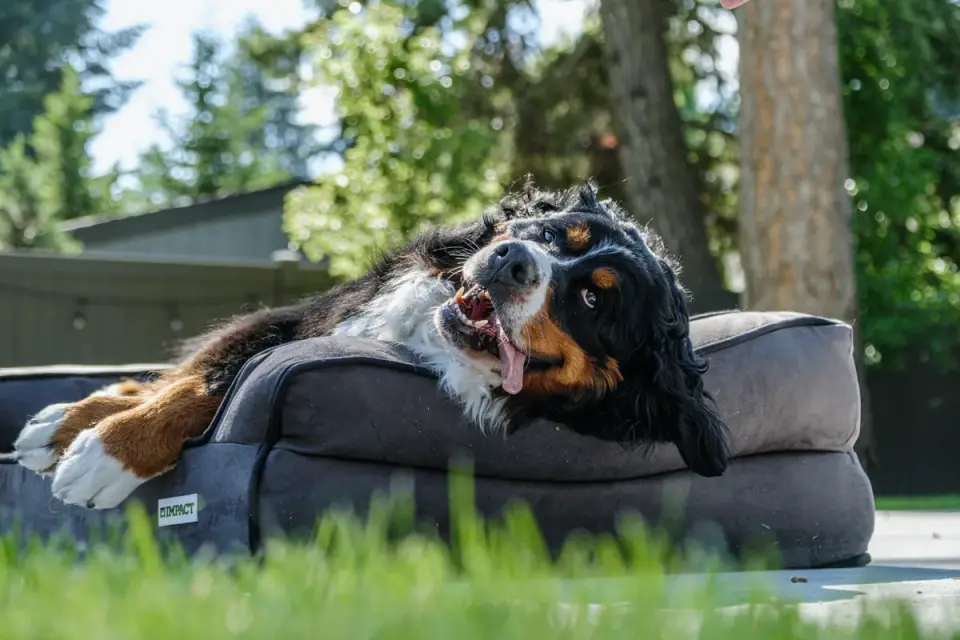
What settles the pattern before bedtime does
Daylight anchors nighttime. Dogs that sleep through the night usually have three things: sufficient daytime exertion without late-evening spikes, predictable evening cues, and a defined resting place that is never used for punishment. I prioritize a morning sniff walk plus midday mental work, a calm early-evening walk, then lights low, voices low, and the same bed in the same spot.
The failed shortcut I see most often looked like this. A 3-year-old 62-pound pit bull mix was wired until 3 a.m., barking at hallway noises and chewing bedding, and his owner tried stacking interventions at 10 p.m.: an extra-hard fetch session, a new crate cover, white noise, and a late heavy meal to make him drowsy. By day 10 the log showed the opposite of rest, with wake-ups moving earlier and panting lasting longer once awake. The late intense play had raised arousal and body temperature right before the handoff to sleep, the covered crate trapped heat and sound vigilance, and the heavy meal created restlessness instead of heaviness. Once we moved exertion earlier, split dinner earlier, and kept the last hour boring and repeatable, nighttime pacing shortened from over an hour to brief resettling.
Supplements fit inside that rhythm, not on top of chaos. A review in Cureus found that “A systematic review analyzed multiple RCTs and concluded that ashwagandha has a moderate positive impact on stress reduction and cognitive performance.” That is general human-centered evidence, not proof a dog will sleep eight hours, so I use ashwagandha forms only as daytime stress-support tools that may help support balance alongside training and routine. If nighttime waking persists beyond two weeks, involves vocalizing, house-soiling, limping, excessive thirst, or sudden behavior change, that is a veterinary exam, not a supplement decision, especially for seniors and dogs on behavior or cardiac medications. Readers dealing with sound triggers should also compare notes with Dog Noise Anxiety: What Actually Helps When Your Dog Panics at Loud Sounds and the broader evidence summary in Dog Anxiety Supplements: What the Evidence Actually Supports.
When night waking is not just anxiety
The edge case that changes my plan is the older dog who looks anxious but is actually uncomfortable. An 11-year-old 34-pound beagle mix began standing at 2 a.m., shifting weight, sighing, circling her bed three times, then lying with her chin up instead of curling on her side. Three weeks in, her owner realized daytime stairs had also slowed and evening play had shortened. Nighttime restlessness in that age group often carries a pain, urinary, cognitive, or temperature component layered over anxiety, and calming support alone leaves the driver untouched. That dog needed joint and cognitive assessment, softer orthopedic bedding near the owner, a late toilet break without bright light or play, and only then a conversation about gentle calming support.
That distinction is the strongest counterargument to my pattern-first approach: what if organizing everything around Shen restlessness misses medical disease. It can, which is why I still land on pattern-first but exam-anchored. The pattern tells us how to sequence care — regulate the day, protect the last hour, support calm physiology — while age, pain signs, new snoring or cough, increased drinking or urination, and any sudden change reset the priority to diagnosis. For storm-specific nights, see My Dog Is Anxious During Thunderstorms: What Supplement Actually Helps? rather than raising the dose of a daily routine.
A short recap: help the nervous system earn sleep during the day so the Shen can settle at night.
Frequently asked questions
Should I comfort my anxious dog when she wakes at night?
Yes, briefly and boringly. Keep lights low, voice quiet, offer a toilet break if needed, then return her to the same bed. Long reassurance sessions can accidentally train waking as social time.
Do calming chews make dogs sleep through the night?
No product guarantees sleep-through. Ingredients such as L-theanine, chamomile, and ashwagandha may help support calm balance as part of daytime routine and evening wind-down, but direct nighttime efficacy in dogs is not established.
When is night waking a vet visit rather than an anxiety problem?
Book an exam for sudden onset, nightly vocalizing, panting with no trigger, house-soiling, stiffness, cough, increased thirst or urination, or any change in senior dogs. Pain, urinary, cognitive, and medical causes commonly mimic anxiety at night.
Sources
- Chamomile Evidence Review — MDPI
- Ashwagandha Systematic Review — Cureus
- L-Theanine Review — Nature