What Is NAD+ and How Does It Help Senior Dogs? A Vet's Plain-Language Guide
Medically reviewed by John Langlois, DVM, MSTCVM, CVA, CVMMP — For general education — not a substitute for veterinary care.
NAD+ isn't something you feed your dog directly; what you're actually buying is a precursor molecule that nudges a decades-old cellular repair system back toward youthful function, and the dog-specific evidence for that is real but still early.

People hear “NAD+ supplement” and picture something like a vitamin: swallow it, absorb it, done. That’s not quite how this one works, and the mix-up matters because it changes what you should expect on the label and on the leash.
Before you buy: what to check first
- Precursor, not NAD+ itself. Look for nicotinamide riboside (NR) or nicotinamide mononucleotide (NMN) on the ingredient panel, not “NAD+” as a standalone entry — dietary NAD+ is broken down before it can be absorbed intact.
- A stated milligram dose per serving, not a proprietary blend that hides the number.
- Third-party quality certification. The National Animal Supplement Council (NASC) seal signals an audited facility, adverse-event reporting, and label accuracy — it does not certify that the product works.
- Realistic language on the label. “Supports normal cellular function” is defensible; “reverses aging” is not.
- A plan for reassessment, ideally with your vet, at the 6- to 8-week mark rather than an indefinite auto-ship.
Each of those points earns its own explanation, so here’s the lifecycle version of what’s actually going on.
Early and mid life: NAD+ is doing quiet, constant work
Every cell in your dog’s body runs on nicotinamide adenine dinucleotide, or NAD+, as a coenzyme in energy metabolism and in DNA repair. It’s also the fuel that a family of proteins called sirtuins need to do their job regulating cellular stress responses. In a young, healthy dog this system runs at full capacity without you ever noticing it. That’s the baseline everything downstream is measured against.
Middle age: the slow drawdown begins
Researchers studying mammalian aging have documented that NAD+ levels fall as animals get older, and one widely cited explanation is that the molecule isn’t just underproduced, it’s actively consumed faster than it’s replaced. According to a National Institutes of Health-published review, PMC (National Institutes of Health) describes enzymes that degrade NAD+ becoming more active with age, tipping the balance away from repair and toward decline. A separate review in Nature lays out how falling NAD+ and reduced sirtuin activity feed each other, weakening the crosstalk between a cell’s nucleus and its mitochondria.
I think about this the way I think about a joint that’s lost some of its cushioning long before a dog starts limping. The deficit is there before it’s visible.
Senior years: where owners actually notice something
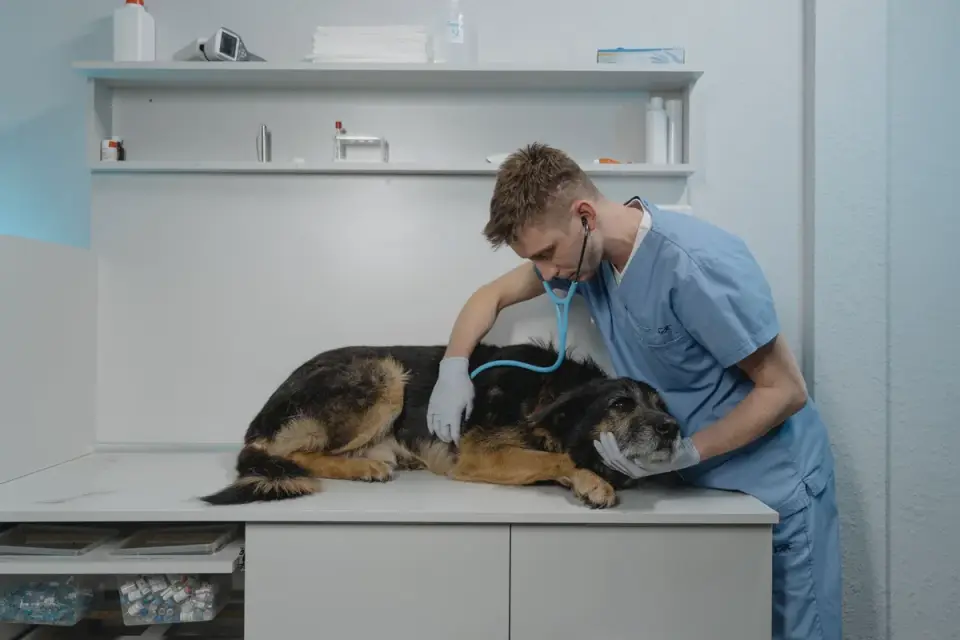
This is where NAD+ decline stops being a lab finding and starts looking like your dog. Slower to rise from the floor. Less interested in the second lap around the block. A grayer muzzle paired with a shorter attention span at mealtime. None of that is diagnostic of low NAD+ specifically, but it overlaps heavily with what mitochondrial and cellular-energy decline is expected to produce, which is part of why NR and NMN moved from human longevity research into dog supplements as fast as they did.
What raises NAD+, and what just rides alongside it
Nicotinamide riboside is the precursor with the most consistent track record across mammalian species; the body converts it into NAD+ through a well-mapped biosynthesis pathway rather than absorbing NAD+ whole. That’s a meaningfully different claim than the antioxidants it’s often bottled with. Quercetin, for instance, is a flavonoid studied for antioxidant, immune, and cellular-support properties, and one in vitro study found that quercetin formulations, along with NAC and ascorbic acid, didn’t change feeding behavior in the Pharmaceuticals (MDPI) nematode model tested — useful mechanistic groundwork, but a long way from a dog’s dinner bowl. Resveratrol carries similar caveats: an embryonic-exposure study published in Phytomedicine found that a specific resveratrol extract accelerated development but shortened adult lifespan in the model organism used, a reminder that dose and life stage change the picture even for a well-studied compound. None of that is a dog-safety finding, and it shouldn’t be read as one; it’s context for why formulators pair these ingredients cautiously rather than treating them as interchangeable with NAD+ precursors.
How this fits a whole-patient approach
In my own practice I lean on acupuncture, Tui-na, and medical manipulation for a lot of senior mobility cases, and I’ve come to see cellular-support supplements as one input among several rather than the intervention. A dog whose stiffness improves with manual therapy and a home exercise plan is often the same dog whose owner also asks about NAD+, and I’d rather frame the conversation around whole-patient balance than around a single ingredient carrying the whole workload. Traditional Chinese veterinary medicine has long paired herbal support with manual work for exactly this reason: no one input is expected to do everything on its own.
What I tell owners is that these ingredients may help support the cellular side of aging while manual therapy, weight management, and appropriate joint supplementation address the mechanical side. If you’re also researching joint-specific options, our team broke down how several formulas compare in Best Joint Supplement for Dogs (2026), and if label transparency for a different supplement category is on your mind, What “Human-Grade” Actually Means in a Dog Probiotic walks through the same kind of label-reading skills used above.
The category is crowded now. Brands like Leap Years, Zesty Paws, LongTails, and Forever Dog Lab all sell some version of an NAD+ or NAD+-adjacent chew, and a UK outfit called NAD for Animals and the professional line ThorneVET are working similar territory from different angles. That’s not an endorsement of any of them; it’s just the honest state of the market, and it’s exactly why the checklist at the top of this piece matters more than any single brand’s marketing copy.
What to realistically expect
Give a precursor-based product 6 to 8 weeks, track something concrete like willingness to take stairs or duration of the morning walk, and loop your vet in before starting if your dog has liver, kidney, or cardiac disease. Some brands publish their own owner surveys reporting improvement, and those numbers are worth a skeptical look, not automatic trust, since they aren’t controlled clinical trials. NAD+ biology in dogs is a genuinely promising area of research. It just isn’t a finished one yet, and a good supplement should be sold that way.
Frequently asked questions
Is NAD+ itself in these supplements, or something else?
Almost never NAD+ directly. Most products contain a precursor such as nicotinamide riboside or nicotinamide mononucleotide, which the body converts into NAD+ through its own biosynthesis pathway. That precursor framing applies broadly across the category, not to one brand, and it's the single most useful thing to check on a label.
How fast should I expect to see a change in my senior dog?
Cellular support ingredients work on a maintenance timeline, not an overnight one. Most vets suggest giving any NAD+-precursor or antioxidant regimen a full 6 to 8 weeks before judging whether it's doing anything, alongside your own notes on gait, appetite, and enthusiasm.
Are quercetin and resveratrol the same thing as NAD+ support?
No. They're antioxidants that get paired with NAD+ precursors in a lot of longevity chews because they target oxidative stress and cellular health through a different mechanism, not because they raise NAD+ levels themselves.
Does my healthy 4-year-old dog need this?
Probably not yet. NAD+ decline is a gradual, age-associated process, and most of the interest (and the label copy) is aimed at dogs in the back half of their expected lifespan, roughly age 7 and up for medium and large breeds, earlier for giant breeds.
Sources
- Why NAD+ Declines during Aging: It's Destroyed — PMC (National Institutes of Health)
- It takes two to tango: NAD+ and sirtuins in aging/longevity control — Nature
- NASC Quality Seal — National Animal Supplement Council (NASC)
- Quercetin formulation study (C. elegans feeding assay) — Pharmaceuticals (MDPI)
- Resveratrol embryonic exposure and lifespan study — Phytomedicine