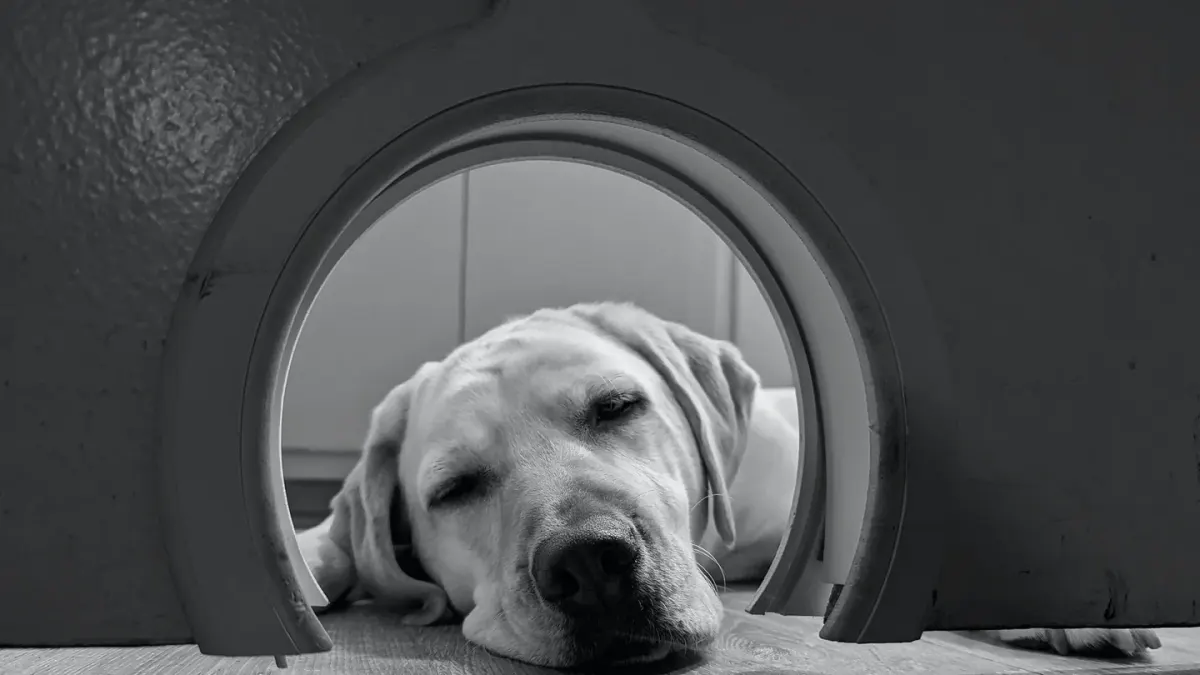
The four-year-old, 47-pound Lab mix I watched in the lobby last spring told the whole story without barking once — tucked tail, weight shifted off her hind legs, quivering through her shoulders as the dryer whined two rooms away, then by day 10 of rehearsed handling at home she could stand on a bath mat for two minutes without bracing. Her owner thought she was being dramatic about baths. What I saw was a dog whose nervous system had already decided the grooming shop meant restraint, noise, and nowhere to move.
What I tell owners in the first two minutes is this: assume shaking is communication until proven otherwise, and start with the body. My bias is to work from the musculoskeletal exam outward — hips, lumbar spine, elbows, and neck — because a dog that hurts when stacked, lifted, or held still will shake on the table even if its temperament is steady at home. The strongest counterargument is that most grooming shakes are pure fear conditioning, and that is often true. I still land on pain-first because missing orthopedic discomfort wastes months on calming strategies that cannot touch the trigger.
Run this quick sort before you assume anxiety:
- Check posture and movement: stiff rising, bunny-hopping stairs, lip-licking when the back is touched
- Check context: does shaking start in the waiting room, only on the table, or only with dryers and clippers
- Check temperature: wet coat plus high-velocity dryer cycling cool air, small or lean dogs chilling fast
- Check handling history: last visit rushed, matted coat pulled, nails quicked, long crate wait
- Check recovery: settles within 20-30 minutes at home versus pacing and panting for hours
Before the appointment: cold, pain, and anticipation do most of the work
Shivering is thermoregulation as well as emotion. A wet, clipped coat on a stainless table under a vent can drop a small dog’s comfort fast, and trembling is how skeletal muscle generates heat. Add a spine that is already sore from arthritis or a prior strain, and standing stacked while the groomer works around the hindquarters loads exactly the tissues that ache when extended.
That is why I palpate paraspinals, gluteals, and longissimus tone before I talk about behavior. A dog that flinches over the thoracolumbar junction, short-strides behind, or sits down to avoid standing is not giving you attitude — it is unloading painful structure. Keep expectations realistic here: joint support and comfort care MDPI: may help support mobility over time, but they do not erase a painful grooming position in one visit. The phrasing matters because Biomedicines reminds us that “For the remaining species, evidence is derived mainly from preclinical studies or traditional use.”
The fix is mechanical first. Ask for a non-slip mat, frequent sit or lie-down breaks, a second pair of hands instead of a tight loop for a brachycephalic or arthritic dog, and a warm towel straight out of the bath. For background on generalized worry versus situational trembling, this overview of dog anxiety supplements helps separate daily anxiety from table-specific fear.
During the groom: restraint, noise, and learned dread
Once pain and cold are addressed, what is left is usually arousal and learned association. Grooming compresses everything dogs find hardest — novel smells, separation from you, prolonged stillness, vibration on the feet and face, and loud dryers — into one continuous restraint period. Shaking, panting, yawning, drooling, and trying to climb off the table are distance-increasing behaviors, not defiance.
The middle of the story is where good plans fail. A seven-year-old, 22-pound cocker spaniel I followed as a composite case had done three weeks of cheerful counter-conditioning with a quiet clipper at home, then shook harder than ever at the shop when the groomer, behind schedule, dried him on high beside a barking shepherd for 40 minutes. The owner felt betrayed by the training. The real lesson was tradeoff: rehearsal cannot compete with flooding, and a longer appointment with forced drying undid gradual gains. We changed the plan to a short trim-only visit, low-noise dryer, morning slot, and owner present for the first 15 minutes — and the trembling narrowed to just nail trims.
Short, predictable visits beat long perfect haircuts for fearful dogs. Ask whether the shop will split bath and cut across days, skip the high-velocity dryer, or let you bring a lick mat. If you are weighing chew options for the car ride and lobby, this evidence review on whether calming chews actually work is a grounded starting point.
After the visit: recovery tells you what it was
Watch the hour after pickup. A dog that shakes off, drinks, and naps is showing acute stress that resolved. A dog that paces, pants, hides, or refuses stairs for the evening is telling you the load exceeded coping — or that handling aggravated structure.
This is where calming ingredients enter honestly, without promises. Chamomile and Valerian Root have been used in traditional herbal care to support relaxation. That traditional-use framing is intentional; it describes history, not proof of effect in dogs on a grooming table.
Similarly, L-theanine is an amino acid found in tea that has been studied for its calming properties. The human literature is narrow — Molecular Psychiatry notes “except for one study on psychotic anxiety (SMD = 0.54; 400 mg/day for 8 weeks)” — so I do not extrapolate a human dose to a trembling terrier. Think of these ingredients as possible background support for an already sound handling plan, not sedation and not a substitute for pain care or training.
Ashwagandha sits in the same category. A systematic review analyzed multiple RCTs and concluded that ashwagandha has a moderate positive impact on stress reduction and cognitive performance, according to Cureus. That finding is in people, and Contains KSM-66 Ashwagandha, a clinically studied form of Ashwagandha for stress support describes the ingredient form, not a guarantee for grooming fear. If you try a supplement, run one variable at a time for two to three weeks, keep grooming parameters identical, and judge by observable recovery — shorter panting time, looser body in the lobby — not by marketing language. Related botanicals carry their own nervous-system nuances, covered here for valerian root and ashwagandha.
The edge case owners miss is the stoic senior. A nine-year-old, 68-pound shepherd mix barely shook at all, stood rigid with a fixed stare, then needed help into the car and skipped dinner — by day 3 he was still slow on stairs. No trembling, but far more significant than the noisy shiverers. Stillness with braced hind limbs, refusal to shift weight, and a flat affect after grooming should prompt a veterinary exam for lumbosacral pain, elbow arthritis, or cervical stiffness rather than more exposure work.
When should you call your veterinarian promptly? Shaking paired with vomiting, diarrhea, collapse, pale gums, vocalizing when touched, new lameness, or trembling that persists at home without triggers deserves same-day assessment. So does any dog that needs heavy sedation to be groomed — that decision belongs with the veterinarian who knows the heart, airway, and orthopedic status, not the grooming loop.
What will I keep rejecting? The idea that shaking means your dog needs a firmer hand, a longer session to get used to it, or a sedating shortcut every six weeks without addressing table ergonomics. Tighten the footing, shorten the stillness, warm the dog, rule out spinal and limb pain, then rehearse in small slices.
What would cause a dog owner to postpone the next full groom and book a vet check instead?
Frequently asked questions
Is shaking at the groomer always anxiety?
No. Fear arousal is common, but cold wet coat, musculoskeletal pain when standing stacked, and noise sensitivity produce identical trembling. Note when shaking starts and how fast your dog recovers at home to help your vet sort the cause.
Should I give a calming chew before grooming?
A chew may help support a calm routine alongside short visits, mat training, and pain screening, but it will not overcome painful handling or flooding. Trial one product at a time and judge by recovery time and body looseness, not by drowsiness.
When is shaking an emergency?
Call your veterinarian promptly for shaking with vomiting, collapse, pale gums, crying when touched, new lameness, or trembling that continues for hours at home without triggers.
Sources
- Biomedicines Chamomile Review — MDPI
- Ashwagandha systematic review — Cureus
- L-Theanine review — Molecular Psychiatry