
A twelve-year-old mixed-breed came into my practice at 58 pounds, stiff through the hips, and — according to her owner — “just not herself” since her longtime walking buddy, a neighbor’s dog, had moved away three months earlier. Nothing on bloodwork explained the change. What had changed was her routine: fewer walks, fewer sniffs at the fence line, fewer chances to move her body around another dog. By week six of reintroducing a twice-weekly group walk, her owner reported she was climbing stairs more willingly and seemed, in her words, “back online.”
That case is anecdotal, and I want to say that plainly before going further: it proves nothing on its own. But it maps onto a growing body of population-level data, and it’s the reason I’ve landed on a specific, somewhat unfashionable position: socialization and enrichment are not a soft, feel-good add-on to a longevity plan. I treat them as mobility and manipulation therapy — the same category I’d put range-of-motion work or a home stretching routine in — because their measurable effect runs through movement, arousal regulation, and use of the body, not through vague notions of happiness.
What the population data actually says
The best evidence here comes from the Dog Aging Project, an open-data cohort study following tens of thousands of companion dogs. Its social determinants analysis found that dogs with richer social environments — more human contact, more animal companionship — carried fewer owner-reported diagnoses of conditions like osteoarthritis, allergies, and gastrointestinal disease. That finding is described in the Social determinants of health and disease in companion dogs: a cohort study from the Dog Aging Project: Social determinants of health and disease in companion dogs cohort study, and the effect size was notable enough that UW Medicine Newsroom: UW Medicine’s newsroom coverage reported the social-companionship association as roughly five times stronger than that of household financial stability.
I read that as consistent with what I see in an integrative exam room. A dog who is walked with other dogs, who gets novel terrain, who has a reason to trot rather than plod, is a dog whose joints, fascia, and cardiovascular system are getting regular, varied loading. Socialization, in that sense, is often just enrichment wearing a friendlier name — it drags a dog into motion it wouldn’t generate on its own.
Cognitive outcomes track a similar pattern. The Dog Aging Project’s Evaluation of Cognitive Function in the Dog Aging Project: Associations with Baseline Canine Characteristics: cognitive function evaluation found that the odds of canine cognitive dysfunction rose with age regardless of breed, and that baseline activity and environmental variables were meaningfully associated with cognitive scores. None of this is a cure claim. It’s a pattern: dogs whose days include movement, novelty, and contact with others tend to score better on the measures researchers track, and score worse when those inputs disappear.
Where the enrichment story gets messier
Here’s the failed approach I want to name honestly, because a confident recommendation without a counterargument isn’t trustworthy. A controlled study on aged pet dogs, Behavioural and cognitive changes in aged pet dogs: No effects of an enriched diet and lifelong training, tested a structured enrichment and dietary protocol and found no measurable behavioral or cognitive advantage over standard care. If enrichment is genuinely protective, why did a well-designed trial come up empty?
My read is that the null result is about dose and specificity, not about the underlying idea being wrong. A fixed diet plus a training curriculum layered onto dogs who were already living in a stable home is a much smaller intervention than the contrast the population studies are picking up — which is closer to “socially engaged and physically active” versus “isolated and sedentary.” A structured six-month protocol on top of an already-decent baseline may simply not move the needle much further. I still tell owners this: don’t expect enrichment alone to reverse cognitive decline once it’s underway, and don’t buy a puzzle feeder expecting it to substitute for actual social contact and exercise. It’s one input in a mobility and vitality picture, not a therapy in itself.
The kennel-stress literature backs up why isolation specifically, rather than just “lack of toys,” seems to be the sharper variable. Shelter dogs given supervised social interaction and play showed lower cortisol and fewer stress behaviors than dogs left alone in kennels, and some research has found social isolation to be as detrimental to confined dogs as physical spatial restriction itself. Chronic stress hormones don’t sit quietly in the background; they interact with inflammation, appetite, and — in my experience treating older dogs for mobility complaints — willingness to move at all. A stressed, under-socialized senior dog often just stops offering movement, and disuse compounds arthritis faster than almost anything else I see.
A nine-year-old Labrador retriever I worked with, 71 pounds and recently the only dog left in the household after a companion animal died, illustrates the edge case worth flagging. His owner assumed grief explained his sudden reluctance to take stairs. By day 12 of adding a daily 20-minute leashed walk alongside a neighbor’s dog, his gait had visibly loosened and he was initiating play again. The lesson isn’t that socialization “fixed” arthritis; it’s that in a dog whose mobility decline coincided with social loss, restoring social contact restored enough activity to matter. That’s an easy variable to miss if you’re only screening for orthopedic disease.
What I actually recommend, and why
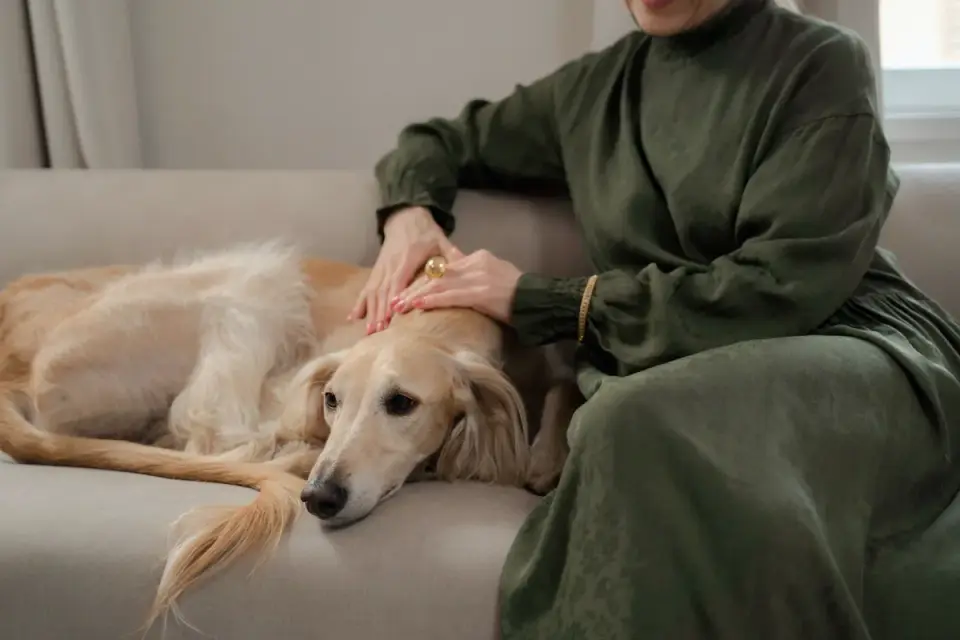
I land on treating socialization and enrichment as part of a mobility-support plan, not a separate wellness category. Practically, that means: regular walks with other known, compatible dogs rather than only solo leash walks; novel-but-safe terrain a few times a week to vary gait and loading; and continued human contact and handling, since gentle touch and calm interaction appear to support the same stress-regulation pathways the cortisol research points to. None of this replaces veterinary evaluation of joint pain, and none of it is a claim that enrichment prevents disease — the honest claim is narrower: dogs who stay socially and physically engaged tend to carry fewer of the comorbidities researchers are tracking, and disuse from isolation tends to compound whatever is already going wrong.
If your dog’s decline coincides with a change in social routine — a companion moving away, a household member gone more often, a shift to solo walks — I’d treat that as a variable worth correcting before assuming the only options left are all medical. For the broader picture of what actually moves the needle on healthy aging, see our priority list for extending a dog’s lifespan, and if sudden behavioral or house-training changes show up alongside reduced social contact, it’s worth reading about why senior dogs suddenly have house accidents before assuming it’s purely medical. Owners looking at cellular-aging support alongside lifestyle changes can also see our plain-language guide to NAD+ in senior dogs.
Does socialization add years by itself? The data doesn’t let me say that with certainty. What it lets me say is that isolation looks costly, engagement looks protective, and the mechanism runs straight through the body — so why would anyone treat it as optional?
Frequently asked questions
Can enrichment toys alone extend a dog's life?
The strongest population data links longer, healthier lifespans to social engagement and physical activity together, not to puzzle toys in isolation. Treat enrichment items as one piece of a broader activity and socialization routine rather than a standalone intervention.
My senior dog seems to be declining faster since losing a companion animal. Is that connected?
It can be. Reduced social contact often means reduced movement and elevated stress hormones, both of which can accelerate the appearance of decline. It's worth discussing with your veterinarian alongside a standard workup for pain or cognitive dysfunction.
Does this mean isolation causes disease?
The Dog Aging Project's findings are associational, not proof of direct causation. What they show is a consistent pattern of fewer diagnoses in more socially engaged dogs, which is reason enough to prioritize social contact, not proof that isolation alone causes any specific condition.
Sources
- Social determinants of health and disease in companion dogs: a cohort study from the Dog Aging Project — National Center for Biotechnology Information
- Sociability is key to a healthier dog's life, study finds — UW Medicine Newsroom
- Evaluation of Cognitive Function in the Dog Aging Project: Associations with Baseline Canine Characteristics — National Center for Biotechnology Information
- Behavioural and cognitive changes in aged pet dogs: No effects of an enriched diet and lifelong training — National Center for Biotechnology Information