Why Does My Dog Eat Grass and Then Throw Up?
Medically reviewed by Jennifer Freeman, DVM, CVA — For general education — not a substitute for veterinary care.
Most dogs who eat grass and then throw up are fine by dinner; the pattern around the vomiting, not the grass, is what tells you whether to worry.
On this page
Imagine a terrier mix who spends the last ten minutes of every evening walk grazing along the fence line, working through blade after blade of grass with the same methodical attention she gives her dinner bowl. Her owner has read that grass-eating is either meaningless or a sign of an upset stomach, and since those two explanations cannot both be true every time, she watches for what happens next. Sometimes nothing does. Sometimes there is a quick, unceremonious retch on the sidewalk before the dog trots on as if nothing happened. The owner’s dilemma is a familiar one to me: wait it out, or call the clinic. My answer depends less on the grass itself and more on the pattern around it — how often, how the dog acts afterward, and whether anything else about her has changed. That pattern, not the grass, is where I actually start.
What Counts As Ordinary Grass-Eating
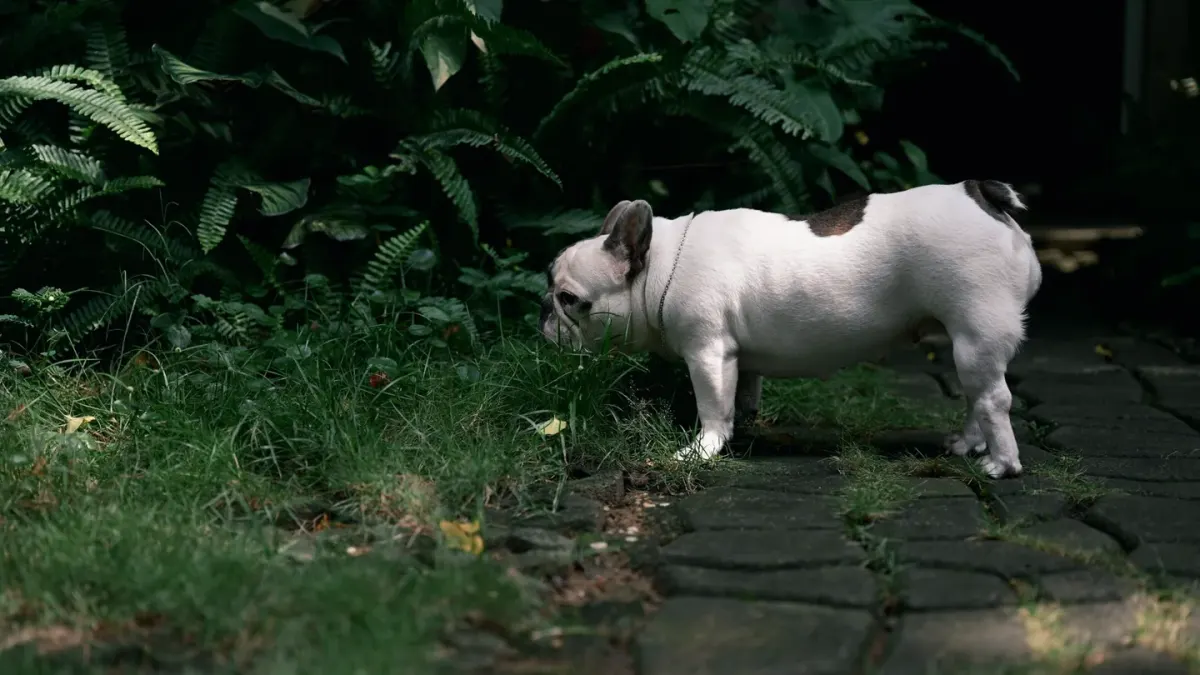
Dogs graze on grass for reasons that have little to do with sickness. Boredom, texture-seeking, and plain habit all play a role, and a dog who eats a few blades on a walk and either digests them without issue or brings up a small amount of foam and grass a few minutes later is behaving within a wide normal range. Grass is fibrous and poorly broken down by a dog’s digestive tract, so an occasional retch after grazing is more a mechanical response to coarse, undigested plant material than evidence of disease. What I ask owners to notice is not whether the vomiting happens, but whether it is isolated — a single event, followed by a dog who is otherwise eating, playing, and behaving normally within the hour.

When It Signals Something More Than Grass
The picture changes when grass-eating and vomiting become a routine rather than an occasional event, especially if it comes with weight loss, a dull coat, or stool that looks greasy or unusually large. In that territory, I start thinking about the gut itself rather than the grass as the trigger. One condition worth naming is exocrine pancreatic insufficiency, where the pancreas stops producing enough digestive enzymes and a dog effectively cannot break down food properly no matter what it eats. A review in JAVMA notes that this condition is treated with pancreatic enzyme replacement therapy, nutritional management using low-residue diets with moderate fat content, and supplementation of cobalamin — a fairly specific protocol, and not one a dog gets to by chance. The same review is candid that the story does not end once enzymes are added back: researchers still need to understand why dysbiosis, an imbalance in the gut’s bacterial population, tends to persist in some of these dogs even after treatment begins, and what might correct it. That kind of honesty from the literature is worth sitting with. It means a dog who initially seems better on enzyme therapy is not necessarily a closed case.
The Gut Microbiome’s Role, and Its Limits
Owners often ask whether a probiotic would have prevented any of this, and I answer carefully, because the research does not support a tidy yes. A 2025 study in Frontiers in Veterinary Science looked at how dogs with digestive issues responded to treatment and found that diversity metrics did not distinguish non-responders from responders — in other words, a more varied gut microbiome was not, by itself, the thing separating dogs who improved from dogs who didn’t. That finding matters because it pushes back on the assumption that more bacterial diversity always equals a healthier gut. For a longer look at how strains, CFU counts, and prebiotic fiber factor into a decent probiotic, our Best Probiotic for Dogs (2026): Our Top Pick, Scored Against the Field guide walks through the scoring in detail, and our explainer on What “Human-Grade” Actually Means in a Dog Probiotic is useful if a label’s claims are the thing giving you pause.
Consider a lab mix who has started eating grass most mornings after breakfast and bringing up a little bile along with it, three or four times a week for a month. Nothing else has changed — same food, same routine, same energy on walks — except this new habit. That dog is not an emergency, but she is also not the terrier from earlier grazing once a week with an occasional harmless retch. The frequency has shifted, and frequency is a pattern worth taking to a vet before it becomes a bigger one. I would rather see that dog for a straightforward exam now than wait for weight loss to make the decision for us. Meeting a dog on its own turf means paying attention to what is different for her, not applying a blanket rule about grass to every case that walks through the door.
What I Watch For Before I Worry
Frequency matters most: an occasional episode is different from a weekly or daily one. Appetite and energy matter almost as much — a dog who eats grass, vomits once, and is otherwise herself is telling a different story than a dog who is also picking at meals or seems tired. Weight and coat condition, tracked over weeks rather than days, catch slower problems that a single vomiting episode won’t reveal. And timing relative to meals, medication, or a recent diet change often points toward the actual trigger faster than the grass itself does.
What To Do If It Keeps Happening
If the pattern shifts from occasional to routine, the next step is a vet visit, not a new supplement bought on a guess. Bring a log if you can — dates, how often, what came up, and how the dog acted afterward — because that record does more for a diagnosis than a description from memory ever will. A vet may want bloodwork, a fecal exam, or in cases with the hallmarks described above, specific testing for pancreatic function. Diet changes, added fiber, or a probiotic may help support a dog’s digestion once a cause is identified, but they are not a substitute for finding out what that cause is first. Realistic expectations matter here: most grass-eating dogs need nothing more than a shrug and a paper towel, and the ones who need more deserve an actual answer, not a guess dressed up as a fix.
Frequently asked questions
Does grass-eating mean my dog has an upset stomach?
Sometimes, but not reliably. Many dogs graze on grass with no vomiting at all, and some vomit after eating it without any underlying illness. I look at the pattern around the behavior more than the behavior itself.
When should I call the vet about grass-eating and vomiting?
Call if it happens several times a week, if your dog is losing weight or energy, or if the vomiting starts showing up without grass involved at all. Those are pattern changes, not one-off events, and they deserve an exam.
Sources
- JAVMA Review: Exocrine Pancreatic Insufficiency in Dogs — JAVMA
- Frontiers in Veterinary Science: Probiotic Response Patterns in Dogs — Frontiers in Veterinary Science